Uncategorized

Nabal the Fool – Part 2b

“Dear Lord,
I have been re-reading the record of the Rich Young Ruler and his obviously wrong choice. But it has set me thinking. No matter how much wealth he had, he could not– ride in a car, have any surgery, turn on a light, buy penicillin, hear a pipe organ, watch TV, wash dishes in running water, type a letter, mow a lawn, fly in an airplane, sleep on an innerspring mattress, or talk on the phone.

If he was rich, than what am I?”

What are we all? RICH, incredibly rich.

We are also considered rich spiritually – most of us know much about the Bible, have commentaries and Bibles to use, and have a church to go and hear the Word in our own language…that is wealth!

As we read the story of Nabal, the fool we see that he was also considered rich. Our lesson reminds us that there are some pitfalls of wealth. These things arn’t necessarily true of all wealthy people, but they can be. Consider:

  • Wealthy people can become independent spirited. Other people need them, but they don’t need anyone.
    In your spiritual richness do you have an air that sets you apart from others? Does appear that you don’t need fellowship, encouragement from others, or Bible studies because you already know it all?
  • Sometimes for those that are wealthy it’s hard for others to be honest with them. In verse 17 of I Samuel 25 one of Nabal’s servant’s says “a man cannot speak to him.” If someone tried to tell Nabal he was acting foolish he could have lost his position – or his head! Proverbs 23:9 – Speak not in the ears of a fool, for he will despise the wisdom of thy words.
    In our spiritual wealth can someone approach us and tell us about an issue they see in our lives? How will we respond – like a wise man or a fool?
  • It’s easy for wealthy people to assume the worst about others. Later in the chapter we will see that that’s exactly what Nabal did about David. David would be the next king, but Nabal talks to him like he was a low-life that didn’t deserve his time or attention. Wealthy people sometimes feel they can talk any way they want to talk – they own the world! Proverbs 18:23 – The poor use pleas, the rich answer roughly.
    In our spiritual richness do we assume negatively of other Christians? If they don’t have the same convictions as we have or read from the same translation of the Bible do we automatically assume the worst, or think negatively about them?

As we continue to walk through this chapter of I Samuel we read that Nabal was not only rich, but he was “churlish.” In Hebrew this word means, hard, unyielding, unbending, uncontrollable, severe, stubborn, violent, deliberately stiffened. Does this sound like the kind of guy you would want to deal with? He was abusive with his words, abusive to his wife and others. He was just a mean man. There are men and women like that, and sometimes you have to live with a fool.

The Scriptures go on to say that he was of the house of Caleb – he was a Calebite. This can mean that he was a descendent of the godly man Caleb from the tribe of Judah, but some commentators say this is an adjective describing Nabal’s behavior. The word “calebite” means, dog. It can be rendered, “He was snappish as a dog.” I’m not knowledgeable about dog breeds, but I’ve seen some snappish dogs – teeth snarling, barking, mean in their natures. This is what Nabal was like! He is best described by the meaning of his name – fool.

Remember that a fool isn’t someone who is mentally deficient, but morally deficient. It’s someone who says there is no God (Psalm 14:1) He lives life as if there is no God. He has no regard for spiritual things, no fear of God or of man. He has no regard for what is moral, and as a result he acts foolishly. Isaiah 32:6 – And his heart inclines towards wickedness: to practice ungodliness and to speak error against the Lord, to keep the hungry person unsatisfied and to withhold drink from the thirsty. We’ll see later that this is exactly what Nabal did to David and his men.

Why did Nabal act this way? Why do we act foolishly? It’s because of what is in our heart. We will act out of what is there. We speak out of what is there. If we have a foolish heart we will act foolishly.

As we close this second lesson, let’s turn our focus to ourselves rather than Nabal. Let’s be honest and ask ourselves some tough questions. Could any of this be true of me?

1. Am I sometimes impossible to deal with?
2. Can people be honest with me? Or will I blow up?
3. Am I arrogant, proud, harsh?
4. Am I difficult to speak to?
5. Do I assume the worst in others?
6. Do I answer roughly rather than graciously?

The Scriptures say we’re all born fools. We’re all born going our own way. Every single day our heart would lead us astray without the wonderful grace of our God. We need Him initially to give us a heart transplant – take out the foolish heart and replace it with a wise one. Then each day we need to run to Him for grace and wisdom so that we will act graciously, with discernment, and godliness in a world that so much needs to see what a difference Christ can make in our lives. We are rich indeed people!

Uncategorized

Nabal the Fool Part 2

“Dealing with my husband is making me so angry. He won’t listen or talk. He’s just impossible to live with!”

“My boss is frustrating me in my job – she’s always changing her mind.”

“Trying to deal with my stubborn child is a huge disappointment. After all my training, he’s still going his own way.”

There are a host of emotions that can be involved when dealing with a foolish person. If anyone could have felt angry, frustrated or disappointed, I expect Abigail would have had a right to, but we don’t see those emotions displayed as we continue hers’ and Nabal’s story in I Samuel 25:1-3.

We are now introduced to Nabal, who is described in this passage as a wealthy man, owning 3,000 sheep and 1,000 goats. In that culture he was considered rich with these possessions. We also meet his wife, Abigail who is described as “a woman of good understanding and a beautiful countenance.

We’ve already learned that Nabal’s name means fool and he lived up to his name and all the attributes of a foolish individual. How could a person call Abigail a woman of understanding if she married this kind of man?

In the culture in which Abigail was living it was a common practice to have your daughter’s marriage arranged. I read a story recently about a mother and father that accompanied their son and his fiancee to meet with the pastor to sign some pre-wedding ceremony papers. While filling out the forms, the son read aloud a few questions. When he got to the last one, which read, “Are you entering this marriage at your own will?” he looked over at his fiancee. “Put down ‘Yes,’” she said. =) Hmmm, maybe this was a pre-arranged wedding too! It was likely that Abigail didn’t have a say in her marriage– just like the humorous story of the young man and his fiancee, Abigail was probably being forced to marry Nabal. Her father put this together, probably thinking he was doing Abigail a favor marrying her into this rich man’s family. A rich man and a beautiful woman may sound like a wonderful combination, but these are only external qualities, and what is needed most in each of our lives is godly character. The difference in these two individuals’ character is extreme. They are complete opposites.

Whether you’re looking for a mate or encouraging a young person about dating someone, can I urge you to consider godly character traits rather than externals? We focus so much on the outside, but God puts a preeminence on what’s in a person’s heart. ( I Samuel 16:7) Your reputation is what others know you to be – your character is what God knows you to be. What kind of character traits should you be looking for, and what kind of traits should each of us be developing in our own lives? How about:

  • Attentiveness
  • Compassion
  • Diligence
  • Forgiveness
  • Godliness
  • Love
  • Promptness
  • Submission
  • Truthfulness
  • Wisdom
    …to name a few. These traits were sadly missing in Nabal’s life!

A couple applications we can make to our own lives at the onset of the story:

1. The fact that you’re godly doesn’t automatically guarantee that those around you will be godly. I Peter 3 tells us that we can be a powerful influence on others, but there is no guarantee that our godly behavior will cause them to change – they may never change, just as we see in Nabal’s life.
2. You don’t have to let a harsh badly behaved man turn you into a harsh badly behaved woman. Because someone in your life is ungodly doesn’t mean you can’t be godly. We tend to think that our behavior is linked to someone else’s. “I could be a godly wife if only my husband would be a godly husband.” “If my child didn’t push me to the edge I wouldn’t lash out like this!” “My in-laws just know which buttons to push to upset me; I can’t help it!” The fact is, no one can make us behave in an ungodly way. Your responses don’t have to be controlled by others.

Let’s break down the principle even more and say, you don’t have to let a harsh, badly behaved toddler turn you into a harsh badly behaved woman. A harsh, badly behaved teenager, a harsh badly behaved boss, neighbor or in-law shouldn’t turn you into a Nabal-ish woman either!
It’s obvious that Abigail didn’t let Nabal destroy her. She was still a gracious, wise, discerning woman. She kept hold of the promises of God, even though she lived with a fool.

Remember that a fool is not someone who is mentally deficient, but morally deficient. This is the person that has no heart for God and acts as though there is no God. He has no regard for spiritual things, and as a result he acts foolishly. He acts this way because that is what is in his heart.

What’s in your heart? Are you acting wisely or do you see some of Nabal’s foolishness in your own life? If we’re honest, we’d all have to admit that we act foolishly at times. We are all born fools – all going our own way, and were it not for the grace of God we would continue to act as foolishly. If there is anything good in us it is only because He has given us a heart transplant. Oh, may we be more wise than foolish and more like our God than like Nabal!

Lesson #2 will continue on Friday’s posting.

Uncategorized

The Holy Spirit I Will Obey

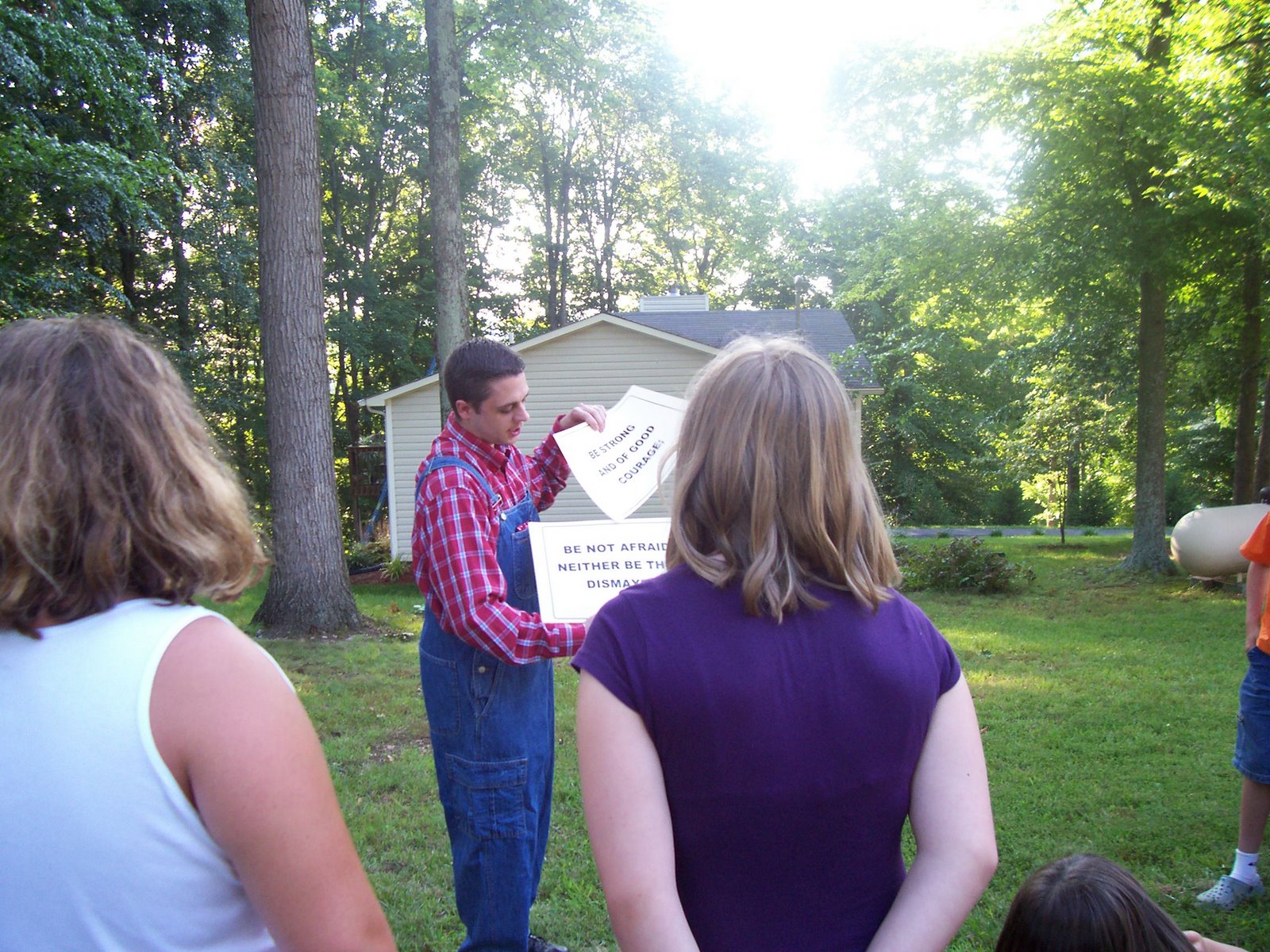
Last night I helped in a Neighborhood Bible Club. What a blessing to see sixteen children gathered in the backyard of a home to sing, learn a Bible verse, and hear a story from the Bible!

One song that was sung was “I’ll Live for Jesus.” Part of the verse says, “The Holy Spirit I will obey, and live for Jesus day after day.” The leader taught the children for a moment about Who the Holy Spirit is. For those who are a child of God, He lives inside of us to convict of sin, to enlighten our hearts to the Truth of God’s Word, and to direct our steps.
I had already had a meeting with Him just a moment before when He gently and lovingly pointed to sin in my heart. When He revealed it to me I shook my head in a defeated, “Oh Lord, I’m guilty again.” How weary I get of myself…I know my sinfulness, I know my heart’s tendencies to go astray. I know how full of self I can become, yet I long so much to honor and glorify my great God – not myself. What joy and delight there is, however, in claiming I John 1:9. Confessing and forsaking my sin brings forgiveness by my loving God. Psalm 66:20 – Blessed be God, which hath not turned away my prayer, nor his mercy from me. He never wearies of my coming to Him to ask forgiveness! He will not turn away from my request. His mercy will never run out!

One day sin will be no more; what a day that will be! Until then we will each need to listen to the gentle tugging of the Holy Spirit in our hearts to reveal to us the sin that is there that breaks our fellowship with our loving God. I’m asking for a more keen awareness of the Holy Spirit’s prompting so I can indeed “Live for Jesus day after day.”
Uncategorized
All You anxiety
Edward Henry Joy
Is there a heart o’er bound by sorrow?
Is there a life weighed down by care?
Come to the cross each burden bearing.
All our anxiety leave it there.
All your anxiety, all your care,
Bring to the mercy seat leave it there;
Never a burden He cannot bear,
Never a friend like Jesus.
No other friend so keen to help you,
No other friend so quick to hear.
No other place to leave your burden;
No other one to hear our prayer.
All your anxiety, all your care,
Bring to the mercy seat leave it there;
Never a burden He cannot bear,
Never a friend like Jesus.
Come then at once; delay no longer!
Heed His entreaty kind and sweet.
You need not fear a disappointment;
You shall find peace at the mercy seat.
All your anxiety, all your care,
Bring to the mercy seat leave it there;
Never a burden He cannot bear,
Never a friend like Jesus.
Uncategorized

The Gift of the Hearth

In yesterday’s patriotic service at our church I participated by reading a monologue as it would be written by the Statue of Liberty. An ending phrase has gone over and over in my mind as I’ve pondered its meaning in my country and my own heart as well. It said, O people, restore me to where I can once again see a land of beautiful homes – A land where homes are never separated – a land where home is viewed more by what is on the inside than what is on the outside – a home where these three gifts will always be: the hearth, the flag, and the place of prayer.

What does it mean to you that you keep alive the gift of the hearth? Wikepdia says that a hearth is “a brick– or stone-lined fireplace or oven used for cooking and/or heating. Because of its nature, in historic times the hearth was considered an integral part of a home, often its central or most important feature: its Latin name is focus.[1] This concept has been generalized to refer to a home place or household, as in the terms “hearth and home” and “keep the home fires burning.” In fireplace design, the hearth is often considered the visible elements of the fireplace, with emphasis upon the floor level extension of masonry associated with the fireplace mantel.

Following this definition I see the hearth as a symbol of the warmth of a family inside a home. It’s not the kind of warmth a real hearth would have brought, but the kind of that comes from being together, spending time talking, sharing in the lives of those that live there with us. I believe this can only be done by the diligence that it took to keep the fire burning in those old- time fireplaces.

One integral part of family warmth is mealtime. I don’t mean the hurry-up and eat and get out of here kind of meal. This is the mealtime where the meal is lingered over, empty plates are pushed back and conversation happens. We have often read a book together after our supper meal. Having Bible reading or devotions works well at this time of day when everyone is gathered together.

The hearth’s warmth can be spread outside to the front porch or the deck. Last weekend we enjoyed having company and spent Friday and Saturday evenings out on the deck talking, sharing dessert and coffee, and also listening to stringed instruments being played and hymns being sung. I could just feel those “home fires burning” during those sweet times of fellowship.

Often the piano in the living room has served as our “hearth.” Because our girls play we have the blessing of being able to gather ’round it and sing together. Game boards have also served in bringing us together in laughter and closeness as games were played with stiff competition and fun.

Each family may interpret the “hearth” in a different way. The important thing is that we do all we can, with the Lord’s strength to keep it burning, and that we each understand that the hearth in the home truly is a gift.